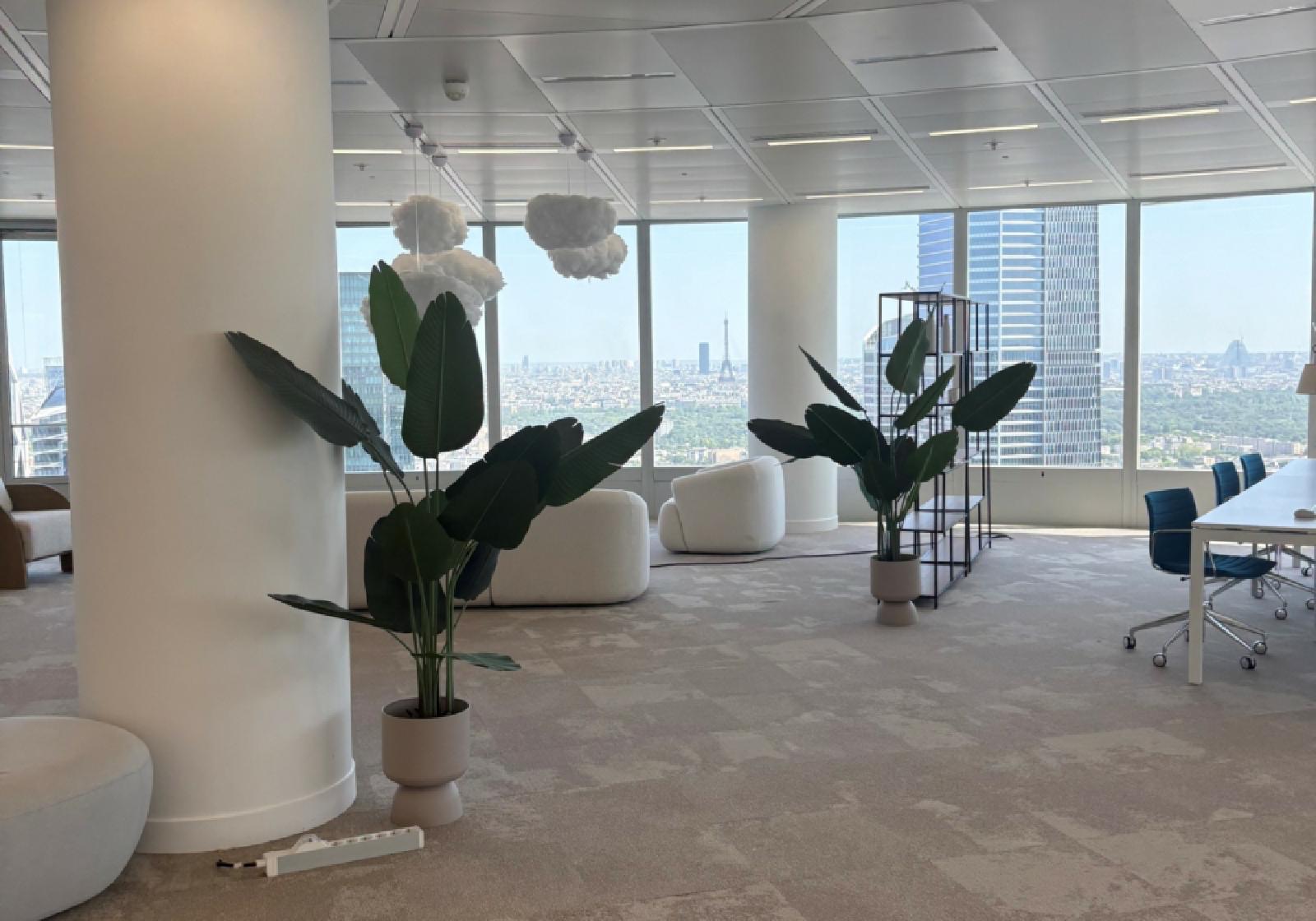
Punch-list tracking and assisted localisation on site
Cœur Défense office floors, Paris La Défense · ART X BAT · TN10 final internship
Context
This was my TN10 final internship at ART X BAT, working in MOEX / OPC — execution-phase client representation, scheduling, coordination and site supervision.
I followed three very different operations: a new build, an urban renovation, and the refurbishment of office floors in a high-rise (IGH) building at Paris La Défense (floors 34–39, Tours A/B). The high-rise became the main case study.
The site constraints were concrete:
- strict access, visitor and authorisation control;
- limited delivery dock, delivery slots and storage;
- heavy trade co-activity and many interfaces;
- highly repetitive office layouts with regular ceiling grids and technical equipment;
- a tight schedule and a surge of punch-list items during OPR (pre-handover operations).
In this context, MOEX/OPC is not about “recording progress”: it is about turning site information into actionable work — locate, describe, assign, follow up, verify.
What I did
Site tracking
- Attended meetings, took notes and clarified technical points;
- checked headcount by trade against the planned progress;
- carried out site inspections, photos and measurements;
- tracked badges, access rights and technical-area authorisation;
- coordinated the delivery dock, transport slots, storage, waste and site traffic;
- updated progress tables by floor and zone;
- wrote clarification, reminder and traceability emails.
Quality and punch list
- Identified and consolidated punch-list items by trade;
- structured them in IDCapture: location, package, contractor, description, deadline, photo;
- maintained statuses: open, contractor-closed, MOE-validated, disputed, rejected;
- used filters and statistics to prepare follow-up lists;
- joined OPR inspections and published consolidated lists;
- set up a dispute form to create a traceable client/contractor process.
Tool rollout
- mapped participants and subcontractors into an account list;
- checked users, roles and permissions;
- prepared cleaned, zone-split PDF drawings;
- designed a three-level contractor / MOE / client validation workflow;
- configured the “site tracking / OPR / handover” sessions;
- coordinated with the software vendor;
- introduced the tool to contractors, shared tutorials and organised training.
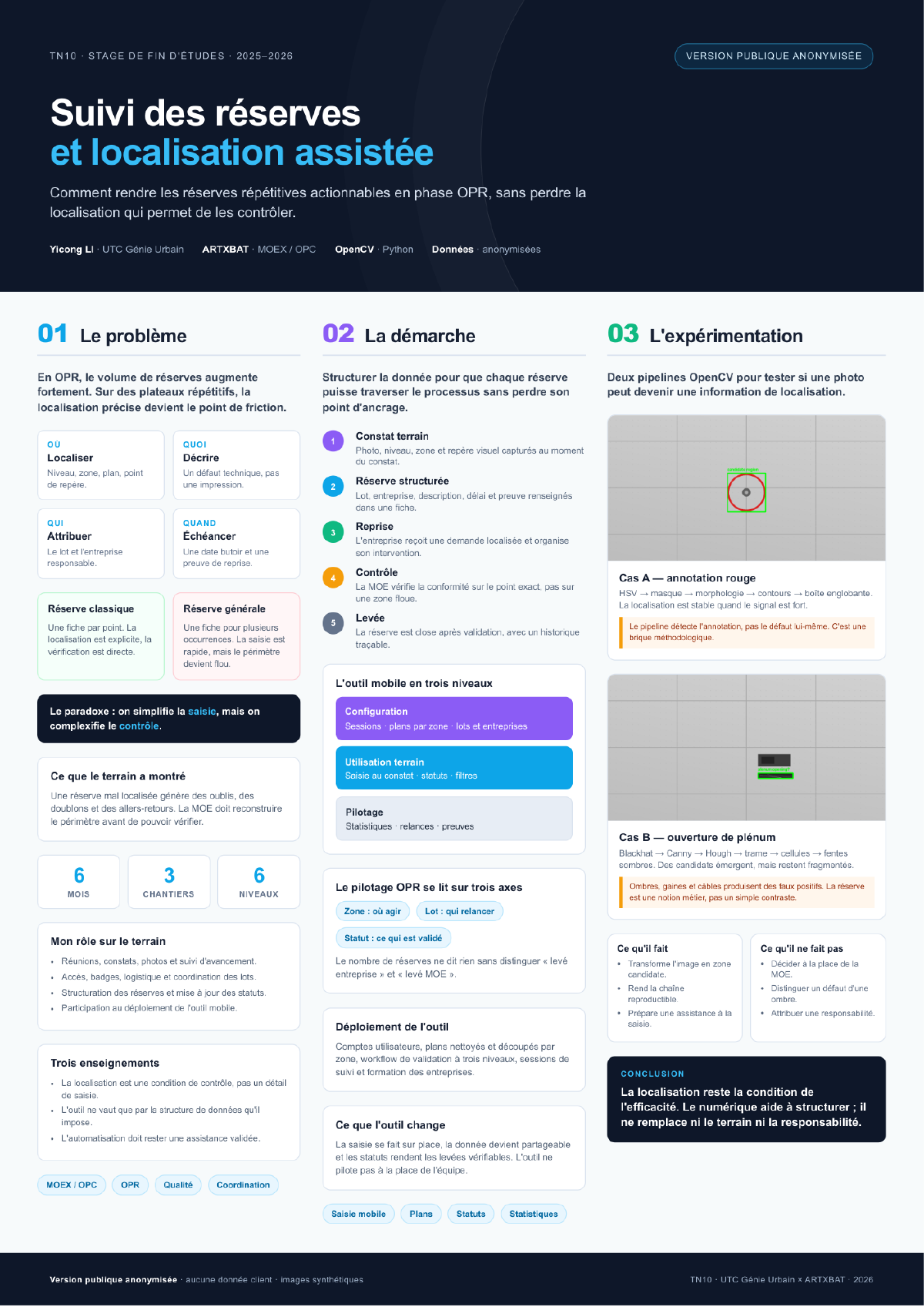
The problem: a punch-list item without a location fails
A useful item answers five questions:
- Where: floor, zone, drawing, reference point;
- What: a sufficiently technical description;
- Who: the responsible package and contractor;
- When: deadline or target date;
- Evidence: photos, status history, acceptance record.
During OPR the number of items rises quickly. In repetitive office spaces, the same defect can appear dozens of times. To reduce input, teams often create a “general item” (réserve générale) grouping several occurrences into one record.
On paper this is efficient. On site, the record loses its precise location: a contractor may fix some occurrences and miss others, while the MOE cannot check how many points existed or whether all of them are closed.
The result: input becomes easier, but verification, reminders and communication become harder; the risk of omissions, duplicates and untreated items rises.
OpenCV prototype
The goal was not to replace people, but to test whether a site photo can produce usable location information. I built two pipelines.
Case A — missing sprinkler rosette
The test image contains a manual red circle:
- convert BGR to HSV;
- isolate the two red hue ranges around 0° and 180°;
- merge the masks;
- apply closing and opening;
- extract external contours and filter small areas;
- convert the main contour into a bounding box.
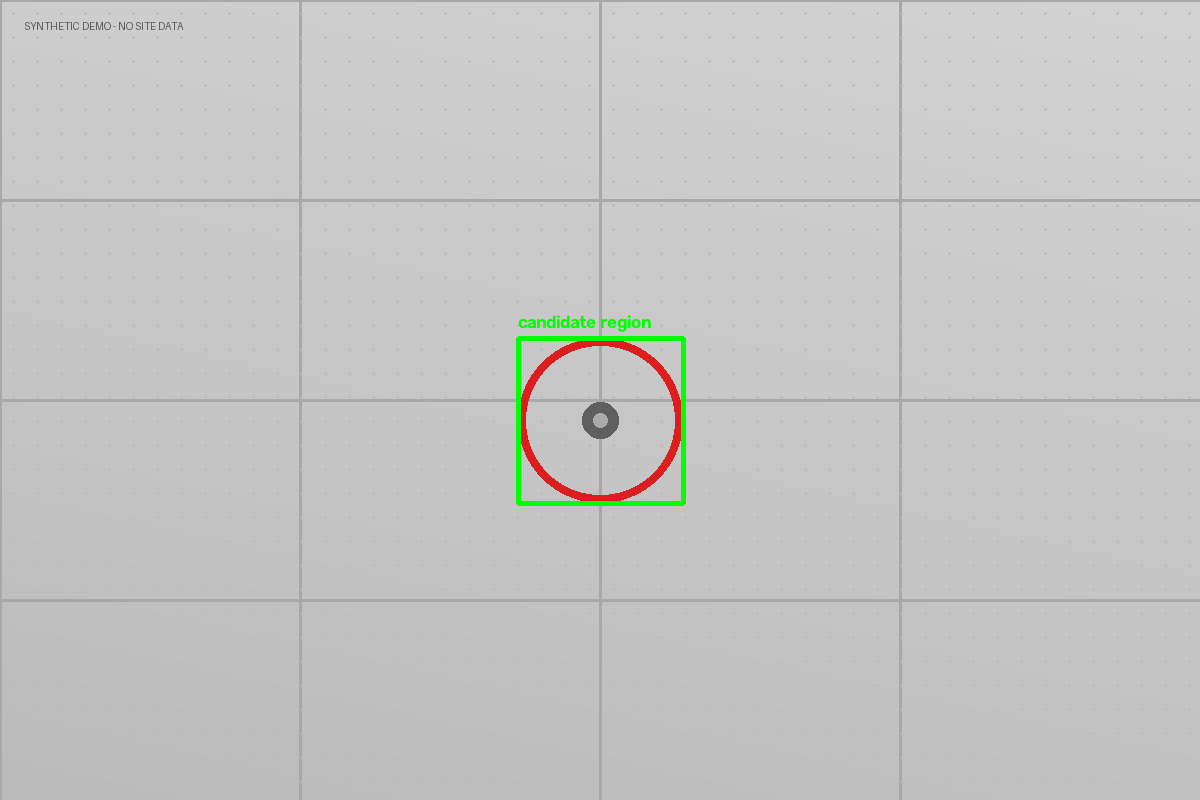
The chain is stable when the visual signal is strong, but it detects the annotation, not the missing rosette.
Case B — open ceiling plenum
This case is closer to reality and does not rely on annotation:
- grayscale and Gaussian blur;
- blackhat with a wide rectangular kernel to enhance dark joints;
- Canny edges;
- HoughLinesP for horizontal and vertical segments;
- merge nearby positions and rebuild the ceiling grid;
- split into cells and compute mean, standard deviation and Laplacian texture energy;
- select “abnormal” cells;
- inside those cells, use blackhat, Otsu thresholding, morphology and area/aspect-ratio/local-contrast filters to find elongated dark openings.
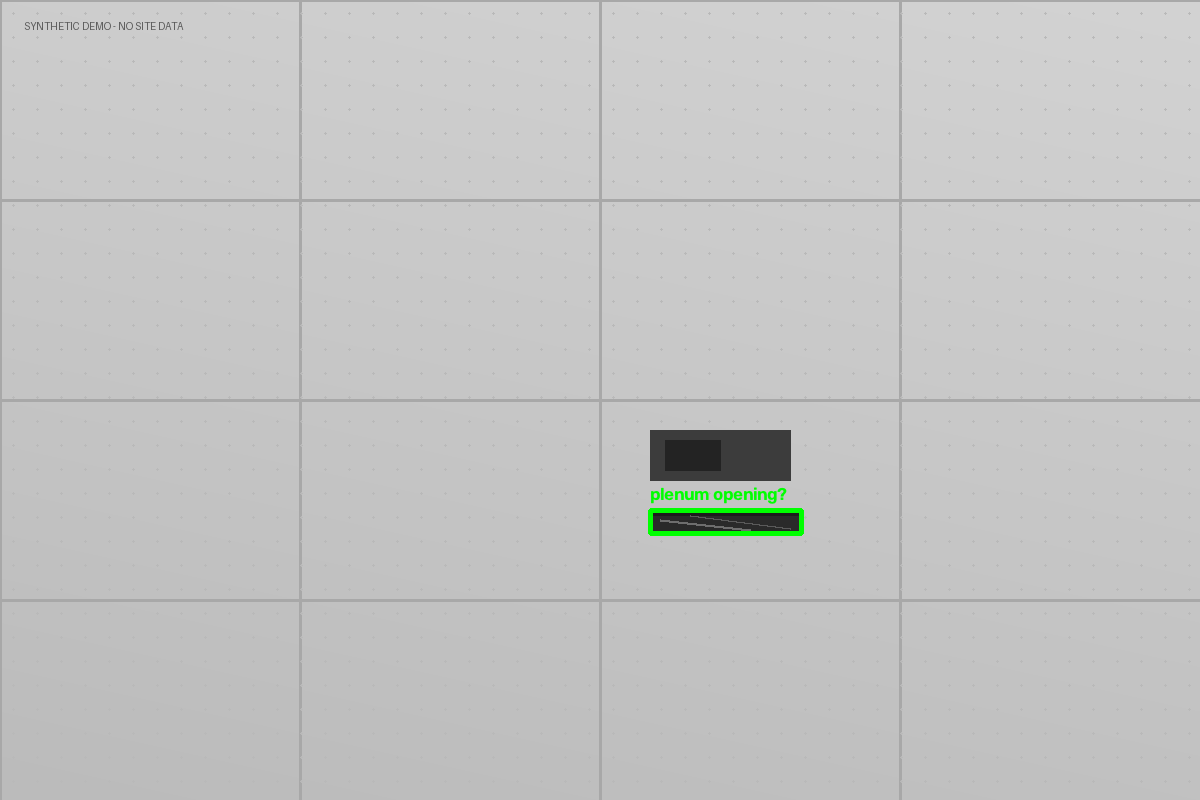
The pipeline produces candidate regions, but one opening may produce several boxes. Site visuals vary too much for fixed rules; a punch-list item is a contractual and engineering concept, not just a dark area.
Results and limits
- Assisted localisation is useful: a photo can become a mask, contour, candidate box or grid cell — the first step towards pre-filling an item.
- A single detection is not enough: a representative annotated dataset, a defect taxonomy by package, an independent validation set and acceptance metrics are required.
- The reasonable automation is assistance: propose a zone, pre-fill a record, then let the MOE confirm.
- Supervised learning was not trained during the internship because of time and missing annotations; the report frames it as a perspective, not a delivered result.
Links
- Company showcase: https://www.artxbat.fr/realisations/bureaux-coeur-defense-pour-bnp-real-estate/
- Public code and redacted material: https://github.com/yicongl1/TN10-MOEX-OPC-Portfolio
- Academic record: /en/undergraduate/utc/#course-TN10
Public files
Technical notes
Related skills
- Excel
- Project management
- AutoCAD